
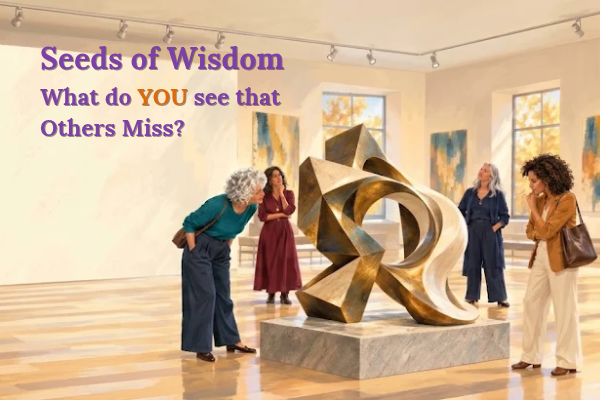
Seeds of Wisdom: What do YOU see that Others Miss?
Let’s play a game.
Imagine you’re one of eight entrepreneurs given the same assignment: Create a new service or a new way to offer an existing service in your business.
You all have at least 10 years of experience in business, and you are clear about who your customers are. You get to decide who will be helped, what the offer will include, and how it will work.
Before you begin planning the service, take a moment to notice where your mind goes first.
· What problem or opportunity immediately comes to mind?
· What would you want to understand before deciding what to offer?
· Would you begin with something customers have requested, something you’ve noticed, or a possibility you’ve been eager to explore?
There’s no single right place to begin. But your starting point may reveal something about how you see your customers, your business, and the contribution you want to make.
Now imagine watching the other seven entrepreneurs approach the same assignment. What would they notice first? Which questions would they ask that hadn’t occurred to you?
Let’s take a peek at the results.
Georgina started with what already works.
Georgina has run a bookkeeping practice for fourteen years, helping small service businesses keep their financial records in order.
She reviewed the services customers consistently requested. Every client needed their books closed each month, but collecting documents, resolving questions, and reviewing results happened differently for everyone.
Georgina’s driving question was: “Is there something here we could deliver more consistently?”
She developed the Monthly Financial Close package. It included a clear scope, dependable schedule, and defined responsibilities. Clients would save time and money by knowing which documents to provide and when. She included a monthly meeting to help them understand their results and plan for the following month.
Her customers would know what to expect, and the business would know how to deliver it.
Georgina naturally noticed what needed to be in place for her clients to count on reliable service from her business.
Sara started with where the business could go.
Sara has spent twelve years helping founders grow their consulting firms. Many of her clients were still the primary service providers while also managing scheduling, client onboarding, billing, and other daily operations. Administrative work had become a bottleneck, leaving them unable to take on more clients.
She stepped back to consider what their businesses needed to become to meet future demand.
Sara’s inquiry was: “If we develop this capability now, look at what it could make possible.”
She designed a program to help owners build a dependable team of contractors to take responsibility for work they no longer needed to do themselves. She developed a process to identify the expertise required and established milestones for selecting contractors, documenting responsibilities, and transferring the work.
With that support in place, her clients could free up time to serve more customers and develop their businesses.
Sara naturally noticed the distance between current capabilities and future possibilities—and began organizing a way to bridge the gap.
Julia started with the customer’s everyday experience.
Julia has owned a home-organizing business for eleven years, helping older adults downsize and move.
As she thought about new services, she remembered clients who called after a successful move because they couldn’t find their coffee filters, reach their everyday dishes, or get comfortable in their new space because something was off.
Her throughline was: “People keep getting stuck here. How can we take care of that for them?”
Julia developed a “First Week at Home” service. She would arrange the kitchen and bedroom, make essential items easy to find, and return after a few days to adjust anything that wasn’t working.
She naturally noticed the needs of her clients that can fall between the steps of an otherwise perfectly reasonable process.
Mariana started with the people her customers were becoming.
Mariana has coached business owners and their teams for fifteen years. She often works with founders whose businesses have grown, but who are not delegating to their team because they still feel responsible for everything.
She listened for their aspirations, recurring relationship challenges, and abilities customers might not recognize in themselves. She wanted to understand what made it difficult for these founders to trust their teams and see their own contribution as leaders.
Mariana’s line of inquiry was: “What would help my ideal clients understand themselves and their teams well enough to move forward?”
She developed a small-group program for founders learning to lead through others. Participants would recognize their strengths, explore their teams’ different perspectives, and practice conversations that helped others take ownership.
Mariana naturally noticed potential and the understanding people needed to develop it.
Sue started with a problem her clients could get their hands on.
Sue has run a technology support business for thirteen years, helping consultants and small service businesses get their everyday technology working.
As she was helping a client fix their booking process, she noticed that once a new customer booked an appointment, the confirmations were not being sent, the information needed to be entered in more than one place, and her client was having to remember too many steps.
Her curiosity focused on: “Show me where it stops working.”
Sue followed the process from booking through confirmation and reminders. She tested adjustments, tried different tools, and worked toward a practical solution.
Once it worked for that client, she realized several other people were experiencing the same issue. She created a “Fix My Booking Process” service to repair gaps between scheduling tools, calendars, and customer communications.
She naturally noticed the point of failure for her clients and what she could change to get things working.
Lisa started by questioning the assumptions her clients were making.
Lisa has spent twelve years helping trainers and consultants develop new offerings. Like Lisa, her clients didn’t lack for ideas about the next course they could offer.
But she noticed a recurring problem: people were completing her clients’ courses and still struggling to apply what they learned.
Her central question was: “What if we’re solving the wrong problem?”
What if those customers already had enough information but needed a different way to put it to work?
Lisa sketched possibilities and combined ideas from education, coaching, and collaborative workspaces. She developed a service to help trainers design and test guided project labs. In these labs, participants would bring a real project, try what they had learned, and receive feedback when they got stuck.
Her clients would have a new kind of offering, and their customers would have a way to turn learning into progress.
Lisa naturally noticed possibilities hidden inside things other people had already accepted.
LuAnne started with someone who needed help now.
LuAnne has operated a movement and fitness business for sixteen years, helping older adults stay active.
Several clients in the same apartment community had stopped attending classes because they were having difficulty getting to her studio.
Her primary drive was: “What can we do to help today?”
LuAnne arranged to use their building’s community room and brought her movement sessions to them. She invited residents to join her and adapted the sessions as she discovered what made a difference for them.
She created a new opportunity for people to use an existing service, shaped through direct contact with those she wanted to help.
Her service took shape through direct contact with the people she wanted to help.
She naturally noticed where concern needed to become action.
Michelle started with an experience that had gone unheard.
Michelle has run a career-coaching practice for eleven years, helping people return to paid work after caring for family members.
Clients described their caregiving years as a gap, even as they talked about managing complicated schedules, navigating unfamiliar systems, and advocating for others.
Her primary inquiry was: “What would support these people in a way that honors what matters to them?”
Michelle developed a small-group program to help former caregivers recognize their abilities, explore work that fit their present values, and tell their professional stories in language that felt truthful.
She naturally noticed whose experience was being overlooked and what a more meaningful response could offer.
Eight entrepreneurs. The same assignment. Eight different places to begin.
Which approach felt most familiar to you? Was there one you read and thought, “Of course. Where else would you start?”
And was there another that made you pause and think, “Huh! I wouldn’t have considered that”?
That’s where this game of being an entrepreneur gets interesting.
Your starting point often seems so obvious that you don’t recognize it as a unique perspective. You probably assume everyone notices the missing procedure, the emerging opportunity, the person who needs support, or the assumption worth questioning.
These examples illustrate the different starting points and underlying patterns of problem-solving for each of the eight Entrepreneur Styles. They aren’t meant to be fixed scripts. Our experiences and circumstances influence how any of us approaches an assignment.
But the question is worth considering: What do you notice so naturally that you assume everyone else sees it too?
Think about the last time a client said, “I hadn’t thought of that,” or “You make this seem so easy.” What had you noticed? What did it help them understand, solve, or accomplish?
Something that comes easily to you may draw on years of experience as well as your natural way of seeing the world. Because you recognize it quickly, you may overlook the value it brings to someone who doesn’t see it at all.
That observation may be the beginning of something your customers value deeply—and something you have barely thought to mention.
Curious about your own Entrepreneur Style?
Understanding what naturally catches your attention can help you recognize your Superpowers and make more deliberate choices about the business you’re building.
Schedule a conversation with me to explore your Entrepreneur Style, and how your perspective contributes to the value you offer.


