
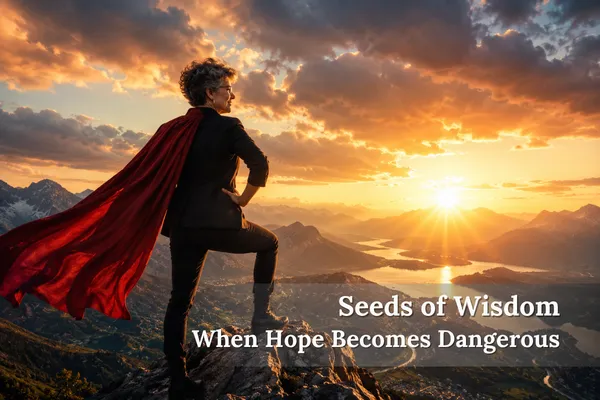
Seeds of Wisdom: When Hope Becomes Dangerous
“All entrepreneurs need to be delusionally hopeful. It’s about hoping that it will get better. That there is a through line, that we will see bigger results.” That’s what my coach said to me last week.
When Hope Feels Dangerous
I was having a really bad day.
She was doing her job as a coach, helping me find the glimmer of hope in the wreckage. I’ve done it thousands of times for my own clients. A big part of being a coach to entrepreneurs is helping them learn from failures, gather themselves up, and wipe away the self-pity tears, and move forward.
But I was spinning out of control and sinking into the belief that my hope had actually become delusional. I was worried that I was chasing an unachievable fantasy and no one around me had the courage to speak up.
I was trying hard to look like someone who wanted to be coached, but I was triggered.
I felt my head detach and float a safe distance from my body. I felt my face freeze into an expression that said I was eager learn the lesson.
Her words morphed into a low mumble like she was speaking through a thick wool blanket.
It wasn’t about what she was actually saying. It was more about what my nervous system had learned those kinds of words could mean.
Learning to Override My Own Voice
I was remembering all the “coaching” sessions I had with my mentor of 25 years. She used the same kinds of language. I often left our appointments feeling broken instead of hopeful. She said I had the wrong mindset or I wasn’t committed enough.
Her solutions involved taking another class with her. I spent a lot of money chasing the hope that one more class, one more retreat would finally fix what was broken inside of me.
When I met her, I was a frightened, highly impressionable young woman. I had not learned to hear my own voice or discern my own heart’s desires from the hopes and dreams that others had for me. I was eager to please and desperately wanted to be liked.
She loved that I had an entrepreneurial drive. But she often coached me into creating products and services that served her needs. One of my early entrepreneurial endeavors was making custom clothing for women, for example. And she convinced me to create a line of clothing that reflected her personal style.
I absorbed her enthusiasm for the idea as evidence of what I should create instead of staying true to my vision.
I wanted to be a star student, so I mastered the fearless entrepreneur act and learned how to appear delusionally hopeful about the future. I envisioned a remarkable future, declared outrageous goals, and learned to do whatever it took to achieve those goals.
I had been trained to override evidence, discomfort, and my own desires in the name of just “believing harder.”
When “Making It Happen” Isn’t Enough
I literally grew up as a professional in this environment and became the highly accomplished woman I am today. When I stepped away from that community, however, it took years to separate the useful tools, insights, and resources I gained from the manipulative tactics and ego-driven agendas.
On the outside, I had a track record of great accomplishments and amazing results. In fact, I am known by many for my ability to “make things happen.”
I became a master manifester. But I was racing down a road toward a vision that wasn’t actually mine.
Hope Needs Discernment and Agency
I still believe entrepreneurs need hope. Hope is what keeps us moving forward when the results are slow, the path is unclear, or the vision has not yet become real. Sometimes we need to be a little delusionally hopeful just to keep going.
But hope cannot be the only force pulling us forward.
What I eventually learned is that hope needs discernment and agency.
Discernment is the internal compass that helps us distinguish between someone else’s agenda and our own True Nature.
Agency reminds us that, no matter how much we value someone else’s insight, the decision remains our own.
I see this with my clients over and over. When they feel cornered and can no longer see their options, it becomes harder to hear their own wisdom. They start looking outside themselves for someone else to tell them what to do. And when they surrender their agency, they begin trusting that someone else knows what is best for them.
That is when hope becomes dangerous.
So, there I was, sitting with my current coach, feeling trapped by words that were intended to encourage me, straining to hear her through that thick wool blanket.
I couldn’t hear my own inner wise voice. I felt like I had lost the two things I treasure most: discernment and agency.
From somewhere deep inside, a small but persistent voice arose. I asked her to stop talking. I said that I couldn’t take in what she was saying. I shared my entrepreneurial origin story with her.
She stayed quiet.
I talked until I could hear my own voice again.
And in that moment, I realized there was a deeper level of discernment and agency I was ready to reclaim.
Reclaiming the Fearless Entrepreneur
In the process of reclaiming myself after I left that mentor’s community, I purged old notebooks and journals and burned some pictures. What I didn’t toss got boxed up and stored in the garage.
After that conversation with my current coach, I realized that I had boxed up my fearless entrepreneur cape in the process.
My current coach reminded me, “The problem isn’t having big ambition and drive; the problem is the application of the drive.”
Entrepreneurs have to believe in things that do not exist yet. We imagine businesses, offers, communities, and possibilities before there is any evidence that they will work. We take risks based on a vision of what could be.
That requires hope. Yes, even delusional hope.
But I no longer believe hope means ignoring the evidence, overriding discomfort, or convincing myself that if I just believe harder, everything will work out.
Hope needs discernment.
Hope says, “Something more is possible.”
Discernment asks, “Is this particular path right for me?”
And agency reminds me, “I get to choose.”
I can listen to coaches, mentors, experts, friends, and people who see possibilities that I cannot yet see. I can learn new skills, try new approaches, and allow myself to be challenged. But none of them gets to decide what success should look like for me.
That is my job.
I pulled my fearless entrepreneur cape out of the box the next day.
As I draped it around my shoulders and tied the bow at my neck, I could feel the blind fearlessness of my younger self being replaced with the bold courage of a wise woman.
I stood taller, feeling the courage of a woman who knows she can make extraordinary things happen. I felt her ambition, her willingness to take risks, and her stubborn belief that a brighter future is possible coursing through my veins.
I don’t need to abandon myself in the process.
So yes, I think my coach was right.
Entrepreneurs need to be a little delusionally hopeful.
We just need enough discernment to make sure the dream we are striving for is actually ours and enough agency to choose the road that takes us there.
What are you delusionally hopeful about right now? And how will you make sure the dream you are pursuing is truly yours?
I’d love to hear what comes up for you. Hit reply and let me know.


